
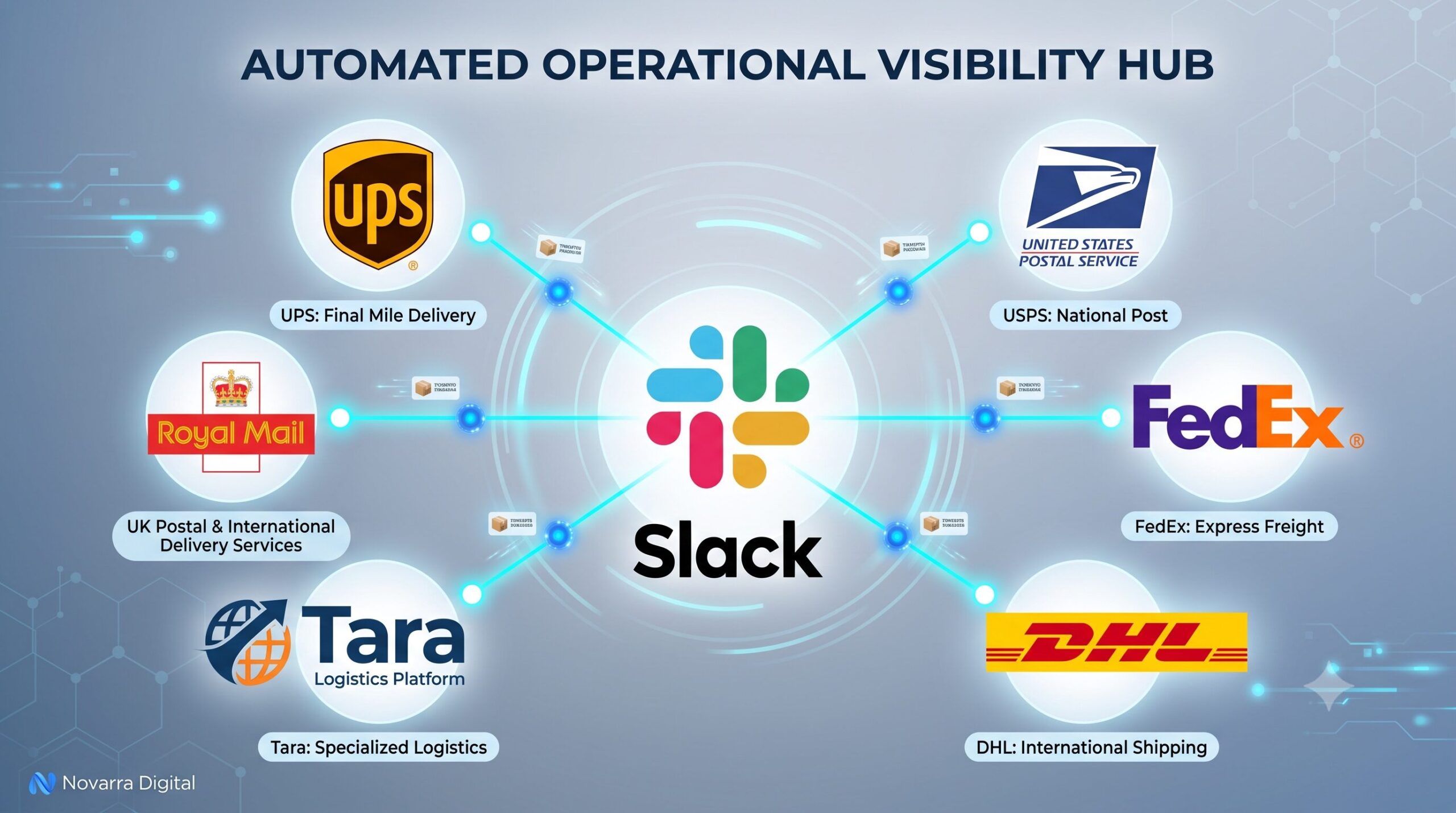
Real-Time Shipping Notification Slack Integration
In fast-moving logistics and fulfillment environments, operational efficiency depends heavily on real-time visibility of shipment status changes. However, most shipping platforms are designed as isolated systems of record rather than communication tools, forcing teams to manually check dashboards or rely on internal relays for updates.
This project focused on building a fully automated event-driven notification system that streams shipment activity directly into Slack, ensuring the entire operations team has immediate and synchronized visibility into all shipping events.
Client Challenge
The client’s operations team was managing a continuous flow of inbound and outbound shipments throughout the day. While the shipping system captured all relevant updates, the communication layer around those updates was inefficient and manually driven.
Key operational issues included shipment updates being locked inside an external portal, requiring constant manual checking. Team members often had to refresh dashboards repeatedly or rely on a single person to communicate changes. This created delays, inconsistencies, and frequent breakdowns in information flow, especially as order volume increased.
The core problem was not data availability, but the speed and consistency of data distribution across the team.
Impact on Operations
| Area | Before Implementation | Operational Issue |
|---|---|---|
| Shipment Visibility | Manual portal checks | Delayed awareness |
| Communication Flow | Human relays (email/chat) | Inconsistent updates |
| Team Coordination | Fragmented information | Misalignment across roles |
| Operational Efficiency | Interrupt-driven workflows | Productivity loss |
| Scalability | Breaks under high volume | Information bottleneck |
Solution Architecture
We designed a webhook driven real time notification system that connects the client’s shipping backend directly into Slack.
Instead of relying on humans to retrieve and distribute updates, the system pushes structured shipment events automatically the moment they occur.
The architecture is based on a simple principle: every shipping event becomes an immediate, structured communication event delivered to the entire operations team.
System Workflow
| Stage | Event Trigger | System Action | Output |
|---|---|---|---|
| 1. Order Creation | New shipment is created | Webhook fires from shipping system | Event payload generated |
| 2. Status Update | Tracking status changes | Event captured in real time | Updated payload triggered |
| 3. Processing Layer | Webhook receiver processes data | Formats and structures shipment data | Clean JSON message |
| 4. Routing Layer | Event mapped to channel rules | Identifies correct Slack channel | Delivery target selected |
| 5. Notification Delivery | Message sent via API | Posts formatted update to Slack | Team receives alert |
Webhook Integration Layer
The core of the system is a self hosted n8n instance acting as a lightweight webhook listener and orchestration layer between the shipping system and Slack.
It receives real-time HTTP POST requests from the shipping platform, validates incoming payloads, extracts shipment metadata, and transforms raw event data into structured, human-readable messages. Within the workflow, conditional logic is applied to determine routing rules, ensuring each update is delivered to the appropriate Slack channel based on shipment type, status, or operational category.
This architecture eliminates the need for polling mechanisms, manual exports, or scheduled synchronization jobs, replacing them with an event-driven execution model where every shipment update is processed and distributed instantly as it occurs.
Notification Structuring Logic
To ensure operational clarity, all Slack notifications follow a standardized format.
Each message includes key operational fields such as shipment reference ID, item details, current status, timestamps, and location data where available. This ensures that every update can be understood in seconds without additional context switching.
The design priority is scan speed, meaning the team can interpret shipment state instantly without opening external systems.
System Behavior Characteristics
The system operates with four core technical characteristics.
First, it is real time, meaning updates are triggered instantly without batching or scheduled intervals. Second, it is push-based, eliminating the need for users to actively retrieve information. Third, it is stateless, meaning each event is processed independently without reliance on historical context. Fourth, it is fully automated, requiring zero manual intervention from staff once deployed.
Results & Operational Impact
After implementation, shipment communication shifted from a manual, fragmented process to a fully automated real-time visibility system integrated into Slack.
| Metric | Before Implementation | After Implementation |
|---|---|---|
| Update Visibility | Manual checks required | Instant notifications |
| Communication Method | Email / verbal relay | Automated Slack delivery |
| Team Coordination | Fragmented updates | Unified real-time channel |
| Operational Load | High administrative effort | Fully automated |
| Scalability | Breaks under high volume | Linear scalability |
Key Outcomes
The entire operations team gained immediate and continuous visibility into shipment lifecycle events without needing to access external systems.
Manual communication bottlenecks were eliminated, and the dependency on individual team members to relay updates was removed entirely. All shipping events now flow into a single centralized channel, ensuring consistent awareness across departments.
The result is a scalable, event driven communication layer that keeps the entire operation synchronized in real time without human intervention.